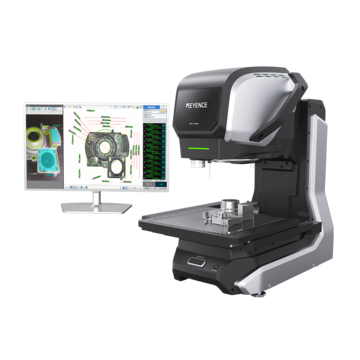
Optical Comparator (Profile Projector)
Machine Cutting Methods and Applications
Machine cutting is a foundational activity in modern manufacturing, as raw stock rarely arrives in the shape required for assembly or installation. Material must be removed to create the features and surfaces that finished parts demand.
This material removal is known as the metal cutting process, where machine tools remove small chips from a workpiece until the desired geometry is achieved.
Machine cutting transforms bars and plates into functional components for industries like automotive, aerospace, electronics, and heavy equipment. Machining, whether manual or CNC, requires controlled tool movements and stable fixturing.
Types of Machine Cutting Processes
Machine cutting processes are chosen based on part geometry, production volume, and material properties. Mechanical machining is the most common method due to its flexibility and repeatable accuracy.
Turning is one of the most recognizable machining operations. The workpiece rotates while a cutting tool moves along its surface to remove material. Lathes are commonly used for this purpose and are well-suited for cylindrical parts such as shafts and bushings, as well as threaded components.
Milling removes material using a rotating cutting tool that travels across the surface of a stationary workpiece. Since milling tools can move along multiple axes, the process is used to create complex shapes, slots, pockets, and different contours. Many modern machining centers combine both milling and drilling with other machining operations to produce finished parts in a single setup.
Drilling creates holes or expands existing openings within a workpiece using a rotating drill bit that cuts into the material. Accurate drilling depends on spindle stability and the correct selection of cutting parameters such as feed rate and speed.
Thermal and abrasive techniques expand the range of available machine cutting methods. Plasma and laser systems cut material by melting or vaporizing the workpiece along a programmed path. Abrasive techniques such as grinding or waterjet cutting remove material via friction or high-pressure streams.
Each of these approaches offers advantages depending on the thickness of the material and the production environment.
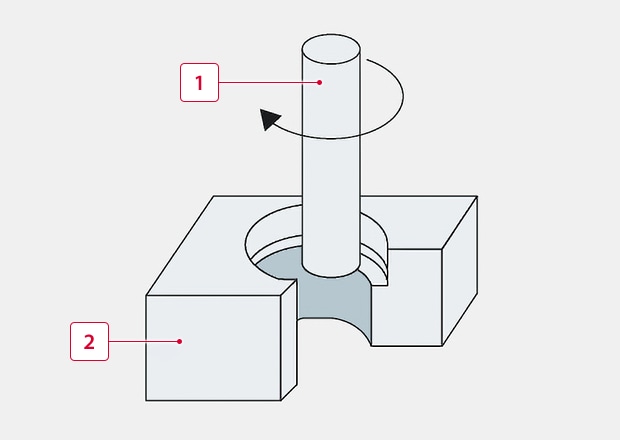
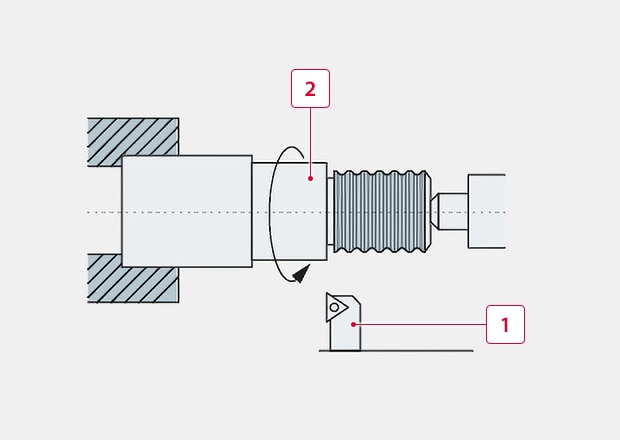
Rolling : Tool turns
Two Methods of Cutting
This section introduces milling as a typical example of rolling, and lathe processing as a typical example of turning, as well as the machine tools used for each process.
-
1Tool
-
2Workpiece
Milling
Milling is performed by rotating a cutting tool called a milling machine mounted on a spindle. Because the tool comes into contact with the secured workpiece intermittently for cutting, a wide variety of machining is possible, including cutting flat planes or curves into the workpiece surface, or boring or grooving the workpiece.
Different types of milling machines are available according to the orientation of the spindle: horizontal machines, vertical machines, and gantry machines, which feature a main body shaped like a gate. Using tools such as face mills, end mills, and slot cutters, these machines cut materials into the desired shape.
Various Milling Cutters
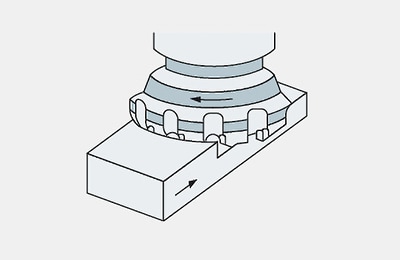
Face mill
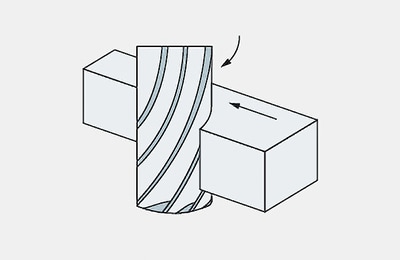
End mill
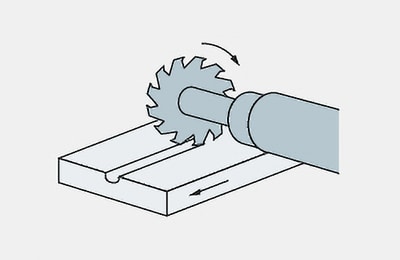
Slot cutter
General-Purpose Milling
General-purpose milling involves the milling operation being performed by an operator. Moving the tool and workpiece in relation to each other, the operator determines and sets the cutting conditions, including the tool position and the feed, speed, and cut amounts. This manual method ensures a refined, high-quality finish.
NC Milling (CNC Milling)
CNC milling involves milling under cutting conditions controlled by a computer. Before CNC milling, numerical control with punch cards were used for milling program control (referred to as NC milling). Today, computer numerical control (CNC) has become the mainstream milling process. The automated operation reduces the labor involved in the process, and enables more complex shapes to be cut through programmed control using 3D CAD or CAM software.
Machining Centers
A machining center is a multi-functional CNC machine that features multiple spindles with different tools mounted, including milling tools. Using a machining center makes it possible to serially combine linear and rotational motions for continuous cutting such as boring and curvature surfacing to create more complex shapes.
CNC Gear Cutting Machines
Computerized CNC gear cutting machines can cut teeth for gears of any shape, size, or purpose for use in daily life, from clocks to automobiles.
Lathe Processing
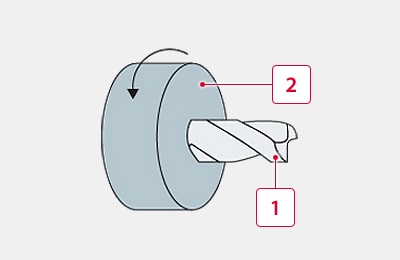
In lathe processing, cutting is performed by pushing a rotating cylindrical workpiece against a cutting tool called a tool bit, which is attached to a spindle. Using a lathe, the periphery of a cylindrical workpiece can be made circular, tapered, drilled, bored to enlarge a hole, threaded, or parted by grooving.
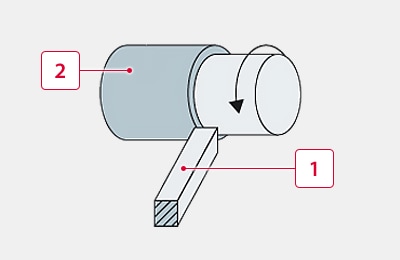
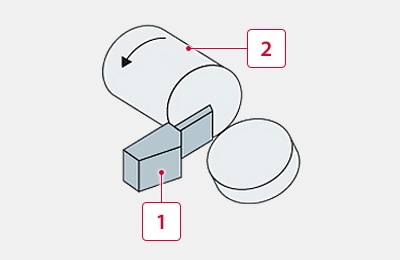
Round-nose cutting
Various Lathe Machining Processes
-
1Tool
-
2Workpiece
General-Purpose Lathe
With general-purpose lathe machines, the operator manually performs feed operations and exchanges tools. The workpiece is held in place by a holder called a chuck, and is rapidly rotated for cutting. With a tabletop bench lathe, small parts can be machined on a workbench.
CNC Lathe (CNC Lathe)
Controlling the machining conditions of lathe processing using a computer makes it possible even for beginners to create products at a certain level of quality. Some models also support automatic changeover of multiple tools for improved work efficiency.
Cam-operated automatic lathes were conventionally used to manufacture the same-shaped products from a long rod material―just like sliced hard candies. In recent years, however, cams have been replaced by programmed control in CNC automatic lathes.
Cutting Tools and Materials
Machine cutting performance depends on the relationship between the cutting tool and the material. Machine tools offer the necessary motion and rigidity for controlled material removal, while the cutting tools provide the sharp edge that executes the cut.
Common machine tools used in machining operations include lathes, milling machines, drills, and saws, and each type supports a different cutting motion. Each is selected based on the geometry of the part being produced. Broaching and boring machines may be used when a workpiece needs an internal feature or requires a hole.
Material properties also influence tool selection. Hard alloys and stainless steel are more costly for cutting tools and often require specialized inserts or coatings. Softer materials can be cut more quickly, but they run the risk of cutting too much or too deeply.
Sheet materials are often processed with shearing or thermal cutting equipment, and bars and tubes are commonly cut with saws or milling machines before any additional machining operations begin.
Improving Accuracy and Speed
Achieving consistent results in machine cutting requires attention to both the machining strategy and process control. Cutting parameters such as spindle speed and depth of cut can influence how efficiently materials are worked with and how stable the cutting process remains.
Proper materials and tools need to be selected for the appropriate job. Toolpath planning plays a role in maintaining consistent force as it moves across the workpiece. Coolant and lubrication are often introduced to reduce heat buildup and help extend the life of the tool set.
Even when machining conditions are optimal, several factors can contribute to variations in metal cutting processes. Tool wear gradually changes the geometry of the cutting edge, which also causes changes in dimensions or can alter surface finish.
Manufacturers can address these challenges by incorporating measurement and inspection into the workflows. Dimension verification systems, like the IM-X1000 by KEYENCE, allow machinists to confirm that any machining operation remains within tolerance. If adjustments need to be made, operators are alerted early on to prevent scrap and rework.
Enhance machine cutting precision with advanced measurement and inspection solutions from KEYENCE.