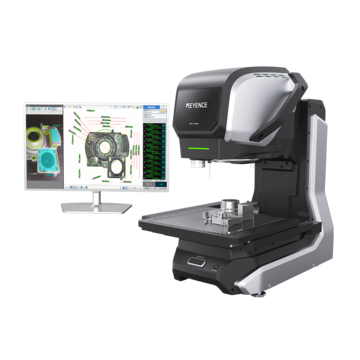
Optical Comparator (Profile Projector)
Precision Measurement for the Power and Energy Industry
Key Takeaways
- Power and energy inspections require portable, high-speed systems that can measure large, immovable components directly on-site.
- Turbine blade inspection relies on full-profile CAD comparison rather than isolated points to detect subtle geometric drifts that impact performance.
- Early dimensional verification during manufacturing and maintenance prevents costly delays and assembly issues in restricted-access environments.
- Advanced metrology systems must maintain data reliability despite environmental challenges like temperature fluctuations and vibrations.
- Integrating contact probing and scanning in a single platform simplifies complex workflows and reduces the need for multiple tools.
The power and energy industry inspections rarely happen under ideal conditions. Components are usually large, and inspections take place where the part is being manufactured, creating portability and high-speed inspection needs. In almost all cases, the component stays where it is, and the inspection process has to work around it.
A coordinate measuring machine (CMM) can be deployed in these environments to capture data of the part and compare it to the nominal geometry; however, in these sectors, the method matters just as much as the result. For immovable or non-repeatable assemblies, energy sector measurement systems must consistently deliver results without needing a controlled environment, distinguishing them from standard inspections.
Inspection of Turbine and Generator Components
Turbine and generator components combine their large size with geometric complexity. Rotor shafts span long distances, and housings can introduce alignment challenges that extend beyond a single feature.
Blade inspection goes beyond a few simple inspection points. For example, airfoil profiles shift along the length of the part, and small changes in curvature or edge geometry can affect performance. Turbine component measurements often rely on sectioning the profile and comparing each slice back to the original data. This can show where the shape began to drift rather than having to confirm where the isolated points fall within tolerance.
Quality Control in Power Generation Manufacturing
Quality control follows the workflow. Fabricated parts and machined components move through multiple stages before installation or return to service, and those measurements have to move with them.
Inspection routines are defined early, but the value comes from how results are used. When data is captured consistently, it can be compared across builds or service intervals.
Early verification also changes the outcome of power and energy industry inspections. Catching a dimensional issue before the final assembly helps avoid correction after installation, where access is limited, and delays are more likely.
Systems, like the WM-6000 by KEYENCE, that can be brought to the part tend to fit into this process better. The wide-area platform allows for measurements to take place near the asset rather than having it in a fixed inspection space.
CMM Inspection for Turbine Components
CMM inspection for turbine components focuses on understanding the full geometry of the part rather than isolated features.
For blades, this means working through defined sections along the airfoil and comparing each one to the CAD data. The result is not just pass or fail, as it shows how geometry changes along the length of the part and where those changes begin to matter.
Different approaches apply depending on the feature. Contact probing works for defined dimensions such as hole location or distance from the edge; on the other hand, scanning captures the surface shape and supports full-profile comparison. Systems that support both reduce the need to switch tools or rebuild inspection routines.
CAD comparison also changes how results are interpreted. Instead of reviewing individual values, teams can see how the part deviates across the entire surface. This visibility supports faster decisions during turbine component measurement inspections.
Improving Reliability with Advanced Metrology Systems
Issues with reliability rarely start as major failures. They begin with small variations that compound over time. Measurement solutions for the energy sector can help catch those changes early.
When inspection data is tracked across parts or servicing intervals, it makes small changes easier to spot. A shift in alignment or a repeating deviation in a machined feature can point to process issues before they escalate.
In some inspection situations, timing also matters as outage windows are limited and inspections have to fit within that schedule. Systems that require long set-up times can slow the process down, while equipment that can be deployed quickly helps keep inspections aligned with the work being done.
Product reliability is significantly impacted by environmental factors like temperature changes, vibrations, and mounting security. Systems addressing these variables ensure data confidence even in non-ideal conditions.
CMM for Power and Energy Industry
A CMM for power and energy industry applications has to be deployable across a variety of areas, easily and handle large measurement ranges, with a variety of different geometries.
Wide-area and portable systems bridge the gap by enabling direct measurements on large assemblies. Systems like the WM-6000 expand inspection range while remaining manageable for a single user, which is crucial when parts are fixed or difficult to move.
At the same time, the system still needs to support detailed inspections; dimensional checks, surface evaluations, and CAD comparison all play a role depending on the part. Bringing those capabilities into a single platform helps simplify inspections across production and maintenance.
For power and energy industry inspection, the goal is not only accuracy but also consistent results under real conditions.
See how KEYENCE measurement systems enhance quality and reliability in energy production. Contact us today.