Optical Comparator (Profile Projector)
Gear Inspection with 2D Vision Measurement Systems: Fast, Accurate, and Automated
Key Takeaways
- 2D vision systems automate gear inspection with non-contact measurement, solving the speed and repeatability issues.
- Virtual tools simulate complex measurements like the over wire method, eliminating physical gauges and manual calculations.
- Measure over 100 dimensions, including minor, pitch, and major diameters, in under 5 seconds, boosting productivity.
- Eliminate fixturing and manual alignment. Operators place the part and press a button for consistent, repeatable results.
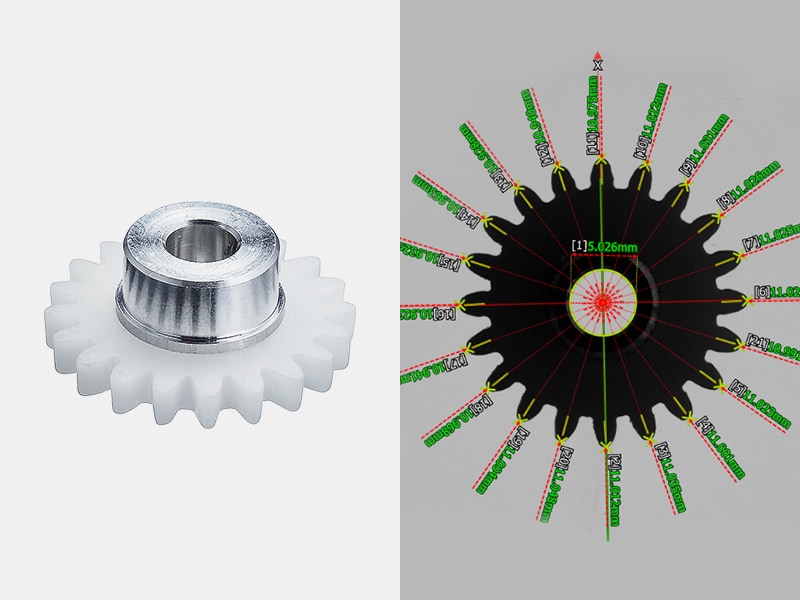
Gear inspection is a critical quality control step in manufacturing applications ranging from automotive and medical to electronics and industrial machinery. Accurate gear dimensions directly affect part fit, function, and long-term performance. Traditional methods like micrometers, comparators, and probe-based systems often fall short in terms of speed and repeatability—especially when measuring pitch diameter, minor diameter, or simulating over wire measurements.
Enter the 2D Vision Measurement System. These non-contact, high-speed systems provide a fully automated solution for measuring key gear geometry. With intelligent edge detection, virtual construction tools, and rapid image processing, vision systems offer a smarter, faster way to perform gear metrology—all with the press of a button.
What Is a 2D Vision System for Gear Inspection?
A 2D vision system uses high-resolution cameras, telecentric optics, and digital processing to measure dimensional features of parts. When used for gear inspection, these systems automatically capture and analyze gear teeth, root diameters, pitch diameters, and more in just seconds.
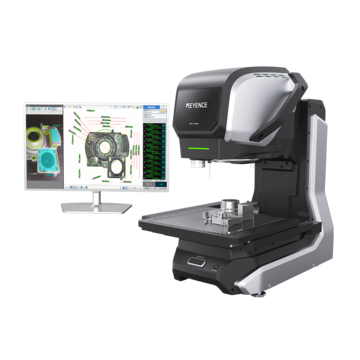
Systems like the KEYENCE IM-X Series require no fixturing or manual alignment. Operators simply place the part on the stage, and the system executes a full gear profile inspection.
Automated Measurement of Gear Features
2D vision systems excel at capturing all critical gear features:
- Minor Diameter: Measured at the root of the teeth, important for clearance.
- Pitch Diameter: Virtually constructed using multiple tooth flanks or midpoints.
- Major Diameter: Captured at the tip of gear teeth to ensure proper meshing.
- Tooth Thickness and Pitch: Automatically calculated using edge detection.
Each measurement is performed automatically with accuracy in the microns and full traceability.
Virtual Geometry Tools Simplify Complex Gear Metrology
Advanced vision measurement systems incorporate virtual construction geometry to measure gear features that don’t appear directly in the captured image. These tools allow visions systems to simulate the following:
- Over wire Method: Virtual points and circles replicate the placement of pins across gear teeth. This allows for the simulation of physical gauges.
- Maximum and Minimum Scanning: Scanning for base and crest locations allow the system to accurately determine Major, Minor, and Pitch Diameter.
- Fitting Lines: By projecting lines of best fit between measurement points, vision systems are able to take angular pitch measurements.
- Projection Circles: Projecting reference circles allows for measurement at specific gauged locations on all parts
These tools allow operators to perform comprehensive gear inspection without overlays, charts, or manual calculation. This not only simplifies the process but eliminates variability from mechanical setups.
Advantages of 2D Vision Systems for Gear Inspection
- Non-Contact Measurement: Prevents set up or use of external gauges.
- Fast Measurement Time: Capture over 100 dimensions in under 5 seconds.
- No Fixturing or Alignment Needed: Just place the part and press start.
- Repeatable Results: Virtual tools eliminate operator subjectivity.
- SPC and Traceability: Full digital records, images, and trend data.

Conclusion: The Future of Gear Inspection is Vision-Based
2D Vision Measurement Systems are changing how manufacturers perform gear inspection. With the ability to measure minor diameter, pitch diameter, and simulate overwire routines—all in one automated process—these systems eliminate the guesswork and variability of traditional gear metrology.
For any organization needing fast, accurate, and scalable gear quality control, a 2D vision system is more than a tool—it’s a productivity multiplier.