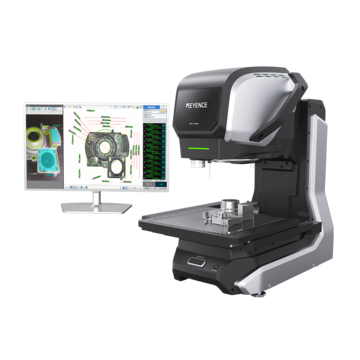
Optical Comparator (Profile Projector)
How AI Is Changing Metrology and Measurement Accuracy
Key Takeaways
- AI in metrology eliminates operator variability by automating lighting, focus, and edge detection, ensuring consistent and accurate measurements.
- Reduce programming time by up to 80% with AI features that automate complex setups, such as lighting and focus optimization.
- Automatically generate measurement programs from CAD or PDF files, eliminating manual data entry errors and accelerating part setup.
- Improve Gage R&R and data reliability by minimizing operator influence, enabling tighter tolerance control and confident automation.
For decades, expert operators have adjusted focus, lighting, and edge detection settings in dimensional measurement. Although these decisions directly affect accuracy and repeatability, they vary widely based on individual experience. AI in metrology changes this by automating optimization procedures that used to require years of industry experience.
Results differ between shifts, technicians, and facilities when the measurement setup is dependent on operator expertise. Parts measured by different inspectors may show varying values due to changes in setup parameters, not actual dimension differences. This makes statistical process management more difficult and erodes confidence in measurement data.
The Role of AI in Technology and Metrology
The use of AI in manufacturing has quickly grown to include predictive maintenance, flaw detection, and welding inspection. Because dimensional measuring requires pattern recognition tasks that are appropriate for machine learning, AI in metrology is a perfect fit.
Dozens of parameters must be manually configured by operators using traditional measurement systems:
- Every measurement point has a focus position
- Lighting angles and intensities are determined by the material and surface polish
- Edge detection thresholds are adjusted to identify features without producing erroneous data
Even seasoned metrologists find it difficult to fully optimize each of these interdependent factors.
AI improves measurement accuracy by eliminating human variability. Algorithms test thousands of parameter combinations automatically and pick settings that deliver the most stable results. The system never tires, doesn’t assume each item is identical to the last, and catches subtle factors affecting edge detection.
This matters because measurement programs often have hundreds of points. Operators frequently compromise accuracy for speed, as there isn’t enough time to fine-tune every measurement. By managing laborious parameter tuning and producing expert-level outcomes, AI optimization removes that trade-off.
AI in metrology has features that manual programming cannot match, going beyond setup automation. Multiple focal planes are captured using depth composition imaging, which then combines them into a single focused image with all of the component surfaces visible. Operators can pick measurement points on complex 3D geometry without guessing which focus position will work.
Smart Assist IM-X: Revolutionizing Measurement Systems
By removing the trial-and-error loop that consumes setup time, the KEYENCE Smart Assist IM-X feature reduces programming time by up to 80% when compared to traditional systems.
Consider the traditional method of programming a stamped bracket with 150 measurement points. You take a picture, select a tool, adjust the focus, and capture the sharp edge. If the default lighting lacks contrast, you’ll need to change it and fine-tune the edge detection to avoid missing the edge or picking up noise. Then, repeat this process 149 more times for each feature with varying settings.
In only a few seconds, Smart Assist automates the complete cycle. The system examines multiple focus settings, takes pictures in various lighting conditions, and verifies the stability of edge detection. Next, it selects the combination that produces the most consistent outcomes. To measure, simply click where.
Smart Assist IM-X handles three key optimizations automatically:
-
1AI Lighting Optimization: Selects from programmable ring illumination with multiple LED colors and angles. What works for bare aluminum fails on anodized coating. Red light might beat white on certain plastics. Smart Assist tests these systematically.
-
2Focus: Addresses parts with big height differences. Transmission housings have mounting faces at different elevations, internal features at various depths, and external surfaces across a wide Z-range. Smart Assist determines optimal focus automatically based on actual geometry.
-
3Edge Detection: Distinguishes real part edges from background noise, surface texture, and lighting artifacts. Threshold values that work on one feature may cause false detections elsewhere. Smart Assist picks settings that reliably find edges without garbage results.
Gage R&R studies demonstrate the improvements in repeatability. Measurement variation is reduced when operator influence is reduced. You can maintain tighter tolerances and identify minor process changes with tighter repeatability. Parts that previously required manual inspection can now be confidently automated with AI in metrology.
Transforming CAD: From Paper Drawings to Digital Overlays
Automated CAD-to-Program automates repetitive design operations using software, scripts, and artificial intelligence. The most impressive AI tool on the IM-X is that it has the ability to take engineered drawings and turn them into digital measurement programs with minimal operator input. This solves one of the biggest time sinks in measurement programming while boosting accuracy.
In traditional programming, operators had to choose measuring tools, manually read dimension callouts, locate matching features on the part, and enter design values with tolerances. Each step carried the possibility of inaccurate measurements, misread GD&T standards, and transcribing errors.
The IM-X accepts multiple drawing formats and automates the entire process:
- DXF files: Batch generation automatically places measurement points on all dimensioned features. A 200-dimensional drawing becomes a complete program in minutes instead of hours.
- PDF technical drawings: Identifies dimension callouts and extracts nominal values with tolerance limits. Recognizes feature types like holes, edges, and angles.
- Scanned paper prints: Uses the built-in camera to capture images. Character recognition pulls dimension values and tolerances even from poor print quality, handwritten notes, or faded text.
Instead of searching through dimension lists, you simply click on matching characteristics visually because the drawing overlays on the part image.
Users can measure one-off or low-volume parts much more easily thanks to this. Engineering samples, prototype tools, and custom aerospace components are frequently left waiting for measurement programs. That bottleneck is removed by automated conversion.
By extracting design values directly from CAD data, transcription errors are eliminated. The computation of tolerance stack-ups is accurate. Without any interpretation, GD&T specifications directly connect to accurate measuring algorithms.
Additionally, program upgrades become easier. A few dimensions are altered during drawing revision. Regenerate the program in a matter of minutes by re-importing the updated CAD file. Finding every impacted point, examining new values, revising tolerances, and confirming measuring techniques are all part of manual upgrades.
A procedure that doesn't require in-depth metrology knowledge is produced by combining Smart Assist optimization with automatic drawing import. Instead of months of experience, new operators create accurate programs after little training. With AI in metrology, quality control departments don't need to hire proportionately more professionals in order to scale inspection.
Contact KEYENCE today to enable AI‑assisted inspection on the IM-X Series. Our team can demo how our modular system is designed to meet your unique inspection needs.

FAQs
How do we validate AI‑assisted settings against our PPAP/FAI requirements?
Standard GR&R studies and measurement system analysis can be used to validate the documented parameter sets produced by Smart Assist optimization. The system produces comprehensive reports that fulfill PPAP and FAI documentation standards by displaying the parameters that were chosen, as well as measurement repeatability data.
Can AI‑assisted programs be locked to prevent drift over time?
Yes, after validation, programs can be locked to stop illegal changes. They can still be periodically reoptimized if process changes call for upgrades. Version control and audit trails that display the creation, modification, and authorship of programs are maintained by the system.
What training data (if any) does Smart Assist require for new parts?
Smart Assist requires no prior training data or machine learning model development for new parts. The optimization algorithms analyze the specific part being programmed in real-time, testing parameter combinations and selecting the best settings based on measured edge detection stability.