Continuous Inkjet Printers / Case Coder
Date Coding Equipment: Comparing Today's Leading Date Coding Technologies
Key Takeaways
- Continuous Inkjet (CIJ) printers print faster than contact-based date coders, at speeds up to 600 m/min, making them the standard choice for high-volume lines processing 300+ units/minute.
- Integrated vision inspection (available on KEYENCE's MK-G Series via one-click LAN connection to IV4/CV-X Series) enables automated print verification and OCR validation, supporting traceability and quality-control programs.
- Self-diagnostic maintenance cuts manual cleaning time dramatically and reduces solvent consumption, turning a multi-hour weekly task into a few minutes.
- Non-contact printing works across metal, glass, plastic, paper, and flexible film without equipment changeover, so one printer can serve multiple product lines.
- Variable data integration allows real-time printing of serialization, batch codes, and database-driven content, critical for compliance in food, pharmaceutical, and automotive manufacturing.
Date coding equipment is commonly used for printing expiration date, best by date, or manufacturing date on food packaging or products that require traceability. There are many factors to consider when selecting the right type of date coding equipment such as operating environment, production volume, materials being printed, as well as print content.
Why Date Coding Matters
Date coding equipment prints expiration dates, "best by" dates, manufacturing dates, lot numbers, and batch codes onto packaging and products. Beyond consumer information, this coding is often a regulatory requirement, supporting FDA, EU, and industry-specific compliance, and it's foundational to supply chain traceability, recall management, and inventory control.
Choosing the right date coder depends on four factors:
- Operating environment — temperature, humidity, line speed, and available space
- Production volume — units per minute and shift-length throughput needs
- Substrate type — porous vs. non-porous materials, curved vs. flat surfaces
- Print content — static text vs. variable data, single-line vs. multi-line, barcodes/QR codes
The sections below compare the major technology types, then take a deep dive into Continuous Inkjet, the technology best suited to high-speed, high-compliance production environments.
Date Coding Technology Comparison
| Technology | Best For | Contact Type | Typical Speed | Substrate Range |
|---|---|---|---|---|
| Continuous Inkjet (CIJ) | High-speed, high-compliance lines | Non-contact | Up to 600 m/min | Metal, glass, plastic, paper, film |
| Handheld Stamper | Low-volume, irregular targets | Contact | Manual, low | Varies; prone to bleed/drying issues |
| Handheld Labeler | Retail, price/date labeling | Contact (label) | Manual, low | Flat or near-flat packaging |
| Roller Stamper | Conveyor-fed cardboard | Contact | Line-speed dependent | Cardboard, porous materials |
| Label Printing Machine | Batch food labeling | Contact (label) | Moderate | Water-resistant label stock |
| Hot Printer | Older pillow-pack machines | Contact | Moderate | Packaging film |
| Thermal Printer | Flexible print content, retail | Contact (heated head) | Moderate | Film, label stock |
Understanding How Continuous Inkjet (CIJ) Technology Works
Continuous Inkjet is the workhorse of industrial date coding, a non-contact printing method built for speed, consistency, and integration with quality-control systems.
The basic process:
- Ink pressurization — Ink is continuously forced through the nozzle.
- Droplet formation — The ink stream breaks into tiny droplets.
- Electrostatic charging — Selected droplets receive an electrical charge.
- Deflection plate guidance — An electric field directs charged droplets onto the substrate.
- Gutter recirculation — Unused droplets are captured and returned to the ink system.
Unlike drop-on-demand inkjet, CIJ continuously circulates ink, allowing for high-speed, non-contact printing on moving products. This makes CIJ well suited to fast production lines, including applications requiring printing from a distance, at an angle, or onto curved or irregular surfaces.
Advanced CIJ Features in Modern Systems
Variable Data Integration
- Supports receiving real-time data from production databases (SQL, CSV, Excel)
- Generates barcodes and 2D codes (GS1-128, DataMatrix) alongside text
- Updates print content automatically as products or batches change, no manual reprogramming required
Print Quality Optimization
- Industrial CIJ resolution typically ranges from 100–600 DPI
- Multi-line printing (the MK-G Series supports up to 6 lines)
- Character heights adjustable from roughly 0.6mm to 12.7mm depending on application
Substrate Versatility
- Non-porous: glass, metal, plastic, using specialized inks formulated for adhesion
- Porous: cardboard, paper, using fast-drying formulations
- Typical operating temperature tolerance spans roughly -10°C to 45°C, though this varies by model and ink type
Common substrates in the field:
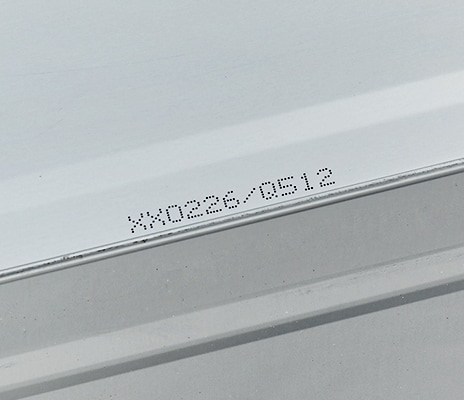
Cans
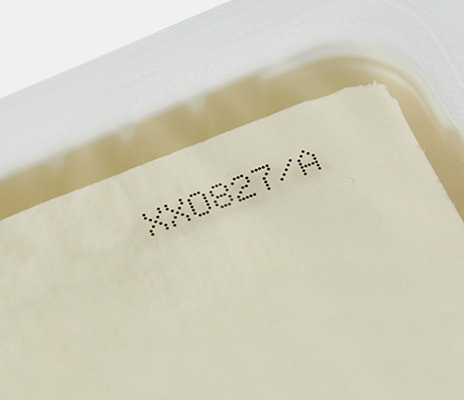
Packaging film
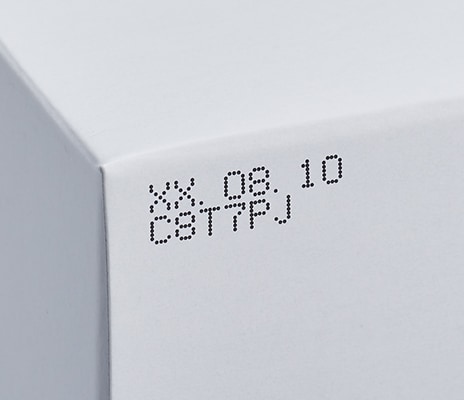
Cartons
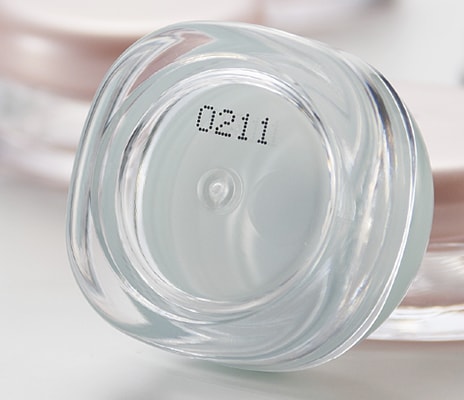
Glass containers
MK-G Series: Integrated Features Worth Knowing
KEYENCE's MK-G Series is a continuous inkjet date coder built around two key differentiators: inspection integration, and self-diagnostic maintenance.
1. Integrated Vision Inspection
Most coding setups require pairing a printer with a separate inspection system, meaning multiple vendors, complex integration work, and manual programming to get the two systems talking to each other.
The MK-G Series connects to KEYENCE vision and inspection systems (IV4 Series, CV-X Series) over a standard LAN cable:
- IV4 Series link enables instant presence/absence inspection of the printed code
- CV-X Series link adds full OCR verification of printed content
- Settings, judgment character strings, and image capture triggers transfer automatically — no manual setup on the inspection side
- Products with missing or incorrect print can be flagged before they leave the line
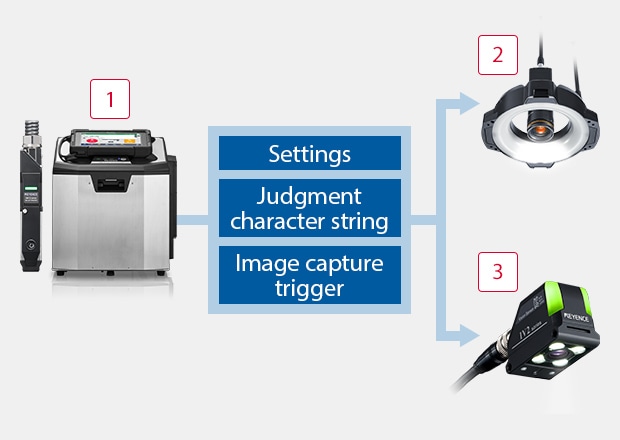
Easily link to a print inspection device with just a LAN cable.
Request a live demo of LAN-based print verification.
System components:
-
1Continuous Inkjet Printer — MK-G Series
-
2Intuitive Vision System — CV-X Series
-
3Vision Sensor with Built-in AI — IV4 Series
2. Self-Diagnostic Maintenance
Traditional CIJ printers require regular manual cleaning to prevent clogged nozzles, dirty print heads, and unplanned downtime. The MK-G Series reduces this maintenance burden with:
- Self-diagnosis identifies common issues and provides troubleshooting guidance
- One-button cleaning replaces manual head-cleaning procedures
- Smart startup — The MK Dock automatically initiates optimized head cleaning.
- Optimized solvent usage — self-diagnosis tunes cleaning cycles to help reduce solvent consumption
| Conventional Head Cleaning | MK-G Series Uniform Cleaning | |
|---|---|---|
| Process | Manual removal of ink adhered inside the head | Press a button - cleaning and troubleshooting handled automatically |
| Startup | Manual setup each time | Smart startup via MK Dock |
| Solvent use | Standard | Optimized through self-diagnosis |
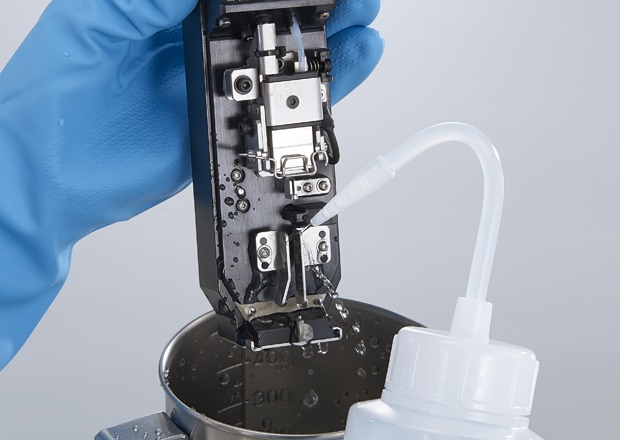
Conventional head cleaning
Manual cleaning had to be performed to remove ink that adhered inside the head.
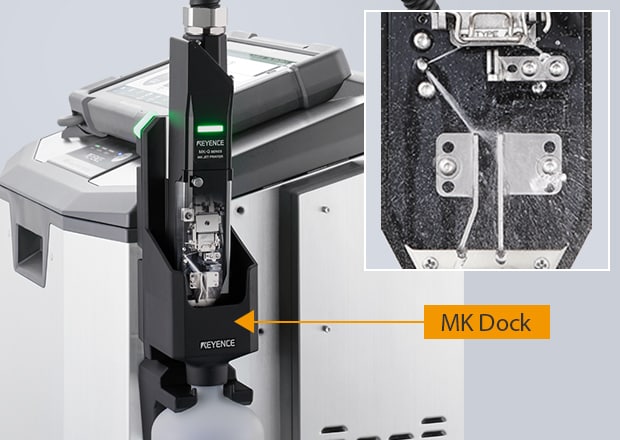
Smart startup
Just placing the print head in the MK Dock starts optimal cleaning of the main head parts.
Alternative Date Coding Technologies
Continuous Inkjet isn't the right fit for every application. These alternative date coding technologies can make sense depending on production volume, substrate, and packaging setup.
Handheld Stampers
Fast-drying ink is transferred manually from type to the target surface. They're suited to low-volume or difficult-to-print applications, but can suffer from inconsistent pressure, bleeding, and drying.
Handheld Labelers
Handheld labelers apply printed date or price labels directly to products. They're useful in retail and low-volume environments, but manual applications can limit speed and consistency.
Roller Stampers
Roller stampers transfer water-based ink onto porous materials such as cardboard as they move along a conveyor. They're simple and effective for compatible substrates, but their ink limitations make CIJ more versatile across different materials.
Label Printing Machines
These machines use thermal printing to produce water-resistant labels with flexible layouts. They're well suited to batch labeling, but labels add consumable costs and an extra application step.
Hot Printers
Hot printers transfer ribbon-based ink onto packaging film using heat, often on older pillow-packaging lines. They remain practical for legacy equipment but offer less flexibility for modern variable data requirements.
Thermal Printers
Thermal printers use a heated print head and ribbon to apply changeable content without traditional type pressing. They're useful when print content changes frequently but remain contact-based and ribbon-dependent compared with CIJ.
Selecting the Right Date Coding Equipment: A Decision Framework
Use this quick self-check to gauge whether Continuous Inkjet is the right fit:
- Production line exceeds 200 units/minute
- Multiple substrate types require coding
- Regulatory compliance requires reliable print verification
- Variable data changes with each product (serialization, batch codes)
- Non-contact printing is required (delicate surfaces, curved objects, moving targets)
- Current maintenance routine takes several hours per week
Scoring guide: 0–2 checked → alternative technologies may suffice · 3–4 checked → CIJ is likely the better fit · 5–6 checked → CIJ is likely essential for your operation
Interested in improving your date coding process? KEYENCE's MK-G Series continuous inkjet printers combine LAN-based inspection integration with self-troubleshooting maintenance, built for reliable, high-speed operation.
Contact us to learn more about the MK-G Series and how it fits your production line

Frequently Asked Questions
What's the Difference Between Continuous Inkjet and Drop-on-Demand Inkjet Printers?
Continuous inkjet (CIJ) systems circulate pressurized ink for high-speed, non-contact printing from a distance or at an angle. Drop-on-demand (DOD) systems eject ink only when needed, offering higher resolution at slower speeds. CIJ is best for high-speed production, while DOD suits detailed, lower-speed printing.
Can Continuous Inkjet Printers Print on Curved or Irregular Surfaces?
Yes. Because CIJ is non-contact, it's well suited to curved, cylindrical, or irregular targets, bottles, pipes, etc. since the print head doesn't physically touch the surface and can print from a range of distances and angles.
What Industries Require Date Coding Equipment?
Most manufacturing sectors that produce packaged or traceable goods use date coding, including food & beverage (expiration/lot codes), pharmaceutical (serialization and regulatory compliance), cosmetics (batch tracking), and electronics/automotive (component-level traceability for warranty and recall management).
How Do I Know if I Need Continuous Inkjet vs. a Simpler Date Coder?
Use the decision framework above. If your line runs at high volume, spans multiple substrates, or needs verified/variable print content, CIJ is typically the better long-term investment.

Related Products
Related Downloads
-
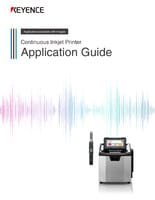
Continuous Inkjet Printer Application Guide
This guide explains continuous inkjet (CIJ) printer applications together with pictures and illustrations. It contains many installation examples in various industries divided into food, medicine, and cosmetics; electrical machinery and electronics; and automotive, metal, and others. These examples show printing on targets specific to each industry.
![Process-specific Marking Applications [Food/Pharmaceutical Industry]](/img/asset/AS_133442_L.jpg)