Static Control
Static Control Solutions for Paper Press Stacker
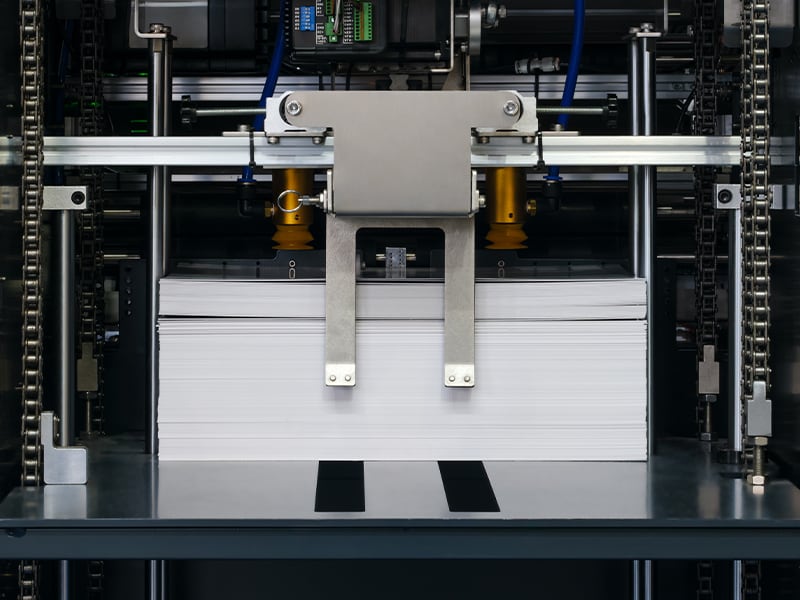
The stacker is one of the most sensitive stages in paper handling. Sheets have to arrive at the paper press stacker in perfect condition; they have to align and separate without issue. They have to withstand even in high-static conditions, such as dry air and high-friction environments.
Static electricity is one of the most common sources of instability during this process. When left unmanaged, it interferes with proper sheet separation and alignment. It also increases the risk of paper jams. That’s why addressing static at the stacker not only supports consistent output but also steadier operation across paper handling equipment.
How Static Electricity Impacts Paper Press Stacker Operations
As paper moves through different presses and cutting equipment, friction and pressure contribute to static electricity charges accumulating on the surface of the product. This is especially true for paper products that are coated or are of a lightweight material (like tracing paper). By the time the sheets reach the press stacker, that charge has been allowed to grow without having anywhere to dissipate. As a result, paper sheets begin to attract or repel one another in unpredictable ways.
This typically shows up in practice as uneven stacking or sheeting clinging together. Corners may also lift or shift before being able to fully settle. Operators may see stacks drift out of their square or see sheets fail to settle cleanly once delivered. When misfeeds happen, the stacker becomes a bottleneck instead of a stabilizing point in the line.
Conventional Countermeasures
Conventional Static Eliminator
The static elimination speed is insufficient.
The static elimination status is not clear.
Countermeasures with Static Eliminators (Ionizers)
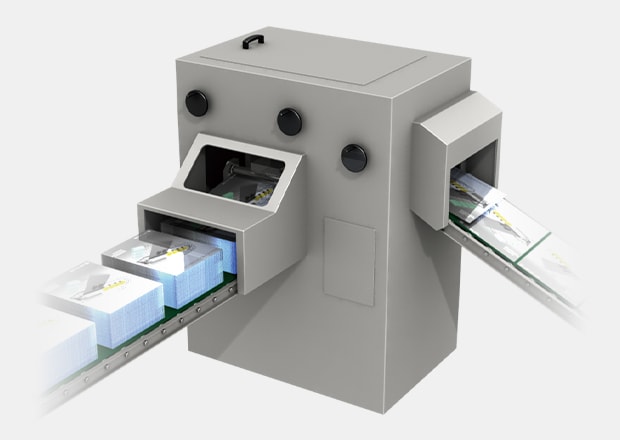
An ionizer can eliminate static electricity and reduce the machine stop time.
Reduced Cost of Machine Stop Time
Cost of stop time: $1,000/month × 12 months = $12,000/year
Benefits of Using Ionizers for Paper Stacker Jamming Prevention
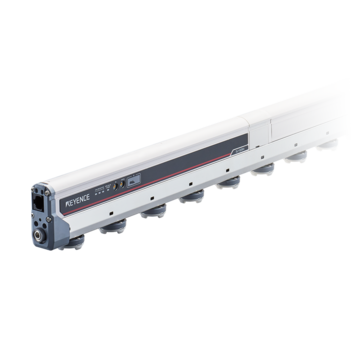
When it comes to static control in the paper industry, ionizers change how static behaves at the point of collection. Rather than allowing static charges to persist until sheets are compressed into a stack, KEYENCE ionizers help neutralize a surface’s static charge. The SJ-Q Series is particularly helpful in areas that require broad coverage across the sheet width. The SJ-E Series and SJ-H Series offer similar benefits, with the SJ-E Series offering an energy-saving option and the SJ-H Series offering an airless option for areas that cannot be subjected to compressed air. This helps charges dissipate before they can cause problems.
Cause of Misalignment Due to Static Electricity
Misalignment in the stacker is rarely caused by a single factor, as static charges interact with paper properties in subtle ways. The smooth and coated surface of paper creates a large contact area between cuts, which increases the effect of an electrostatic attraction. Lightweight sheets lack the mass needed to overcome any attraction if it forms.
The environment can also play a role in misalignment. Low humidity contributes to sheets sticking together and allows static to persist. The longer the sheets travel through the production system, the more static they will hold onto. As sheets arrive at the stacker, all of this influences how the sheets land and how the edges align under compression. Even with the most mechanically sound equipment, static-driven forces can override any alignment controls.
Why Static Elimination is Essential for Paper Handling Efficiency
Paper press stackers are designed to bring order to high-speed paper flow. When static interferes with the functionality of the stacker, the small alignment issues can slow down production. It also puts more pressure on operators who have to monitor the stacks more closely. Static eliminators for paper press stackers address these inefficiencies at their source. By neutralizing charge before the sheets have a chance to settle, ionization supports a predictable stacking behavior across all different paper types and run conditions.
Limitations of Conventional Static Countermeasures
Some manufacturers try to rely solely on traditional countermeasures such as grounding and humidity control. These controls are important, but they do have their own limitations. Grounding can be helpful in industries that handle conductive components, but paper itself is only semi-conductive.
Humidity adjustment can reduce static, though maintaining consistent conditions across different seasons and facilities is often more of a challenge than operators are willing to undertake. Other passive measures, like tinsel (copper or stainless-steel strands), help deplete static as the paper moves under the metal strands. While helpful in some production environments, in high-speed environments, these approaches often just reduce the symptoms instead of solving them.
Improving Process Stability with Ionization Technology
Ionization technology provides actual control measures that can be activated at a moment's notice by generating balanced ions and directing them to the sheet’s surface. Ionizers for press stackers can neutralize charges regardless of the polarity or paper grade. This makes them effective across a wide range of different applications, including press stacks that handle mixed formats or variable run lengths.
Modern ionizers can be integrated cleanly into existing lines and can also be configured to match space constraints and airflow requirements, and, in paper manufacturing environments, this adaptability supports a consistent result that does not require frequent adjustment. Ionization supports process stability by addressing static where the mechanical solutions fall short.
Looking to improve your paper stacker’s static elimination? Request a free static control consultation from KEYENCE today!