CMM (Coordinate Measuring Machine)
What Is Nondestructive Testing (NDT)?
Key Takeaways
- NDT allows for the inspection of materials and components without causing damage, enabling parts to remain in service during and after evaluation.
- Implementing NDT early in manufacturing reduces rework, minimizes downtime, and ensures consistent quality control across production batches.
- Advanced techniques like machine vision and non-contact optical systems provide high-speed, repeatable data, reducing human error in inspections.
- Selecting the appropriate NDT method—such as ultrasonic, radiographic, or eddy current testing—depends on the specific material, geometry, and defect type.
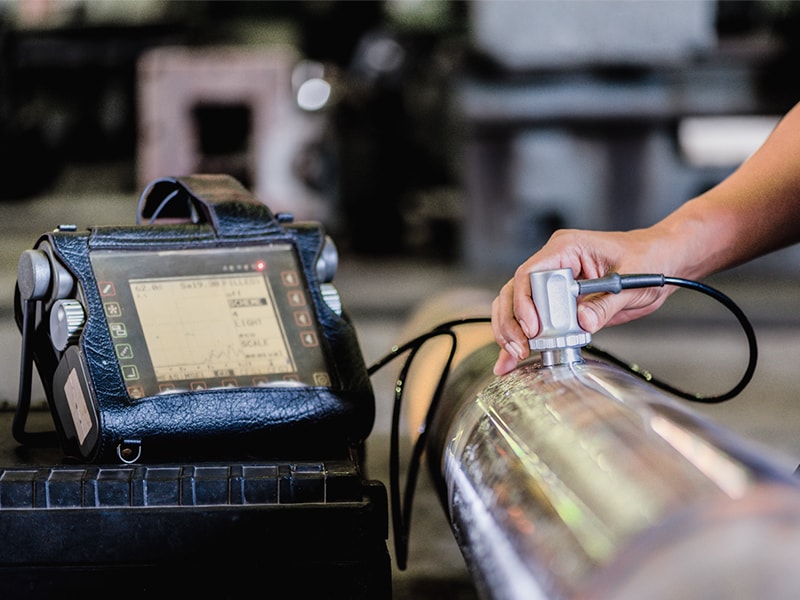
Nondestructive testing (NDT) refers to a group of inspection and evaluation techniques used to examine mat erials, components, and assemblies without damaging them. Unlike destructive testing, where a sample is pushed to failure, NDT allows the part to remain in service after inspection.
This approach is widely used in manufacturing and infrastructure because it allows inspections to happen without having to stop production. A nondestructive testing inspection can be applied during production or after assembly, or while equipment is still operating. That flexibility is one of the reasons NDT has become a standard part of industrial workflows.
At a basic level, NDT methods are used to detect surface defects, internal discontinuities, dimensional variations, and material inconsistencies. As inspection technologies have advanced, NDT methods have expanded beyond the traditional and into optical and machine vision systems, as well as non-contact measurement tools that can capture detailed data in seconds.
Why Nondestructive Testing Is Important
Nondestructive testing plays a direct role in how manufacturers and operators manage quality, safety, and performance because, without it, many defects would go undetected until a product failure occurs.
One of the many advantages of a nondestructive testing inspection is that it allows issues to be identified early. Cracks, voids, corrosion, and other material inconsistencies can be detected before they can affect performance, which reduces the risk of downtime and product recalls.
NDT also supports long-term asset management. Equipment like pipelines, pressure vessels, and structural components can experience wear and tear over time. Regular inspection allows operators to monitor conditions and plan maintenance based on actual data rather than on a fixed schedule.
From a production standpoint, NDT is closely tied to industrial quality control testing, and manufacturers rely on inspection results to confirm that parts meet their specifications and to maintain consistency across batches.
Common NDT Methods Used in Industry
There are a number of NDT methods that are used across industries, but the method chosen depends on material, geometry, and the type of defect being evaluated. While each method operates differently, they all serve the same goal: identifying issues without causing damage to the part.
Some of the most widely used NDT methods include:
- Visual Testing (VT): This method is simply using the human eye and optical aids. Often, this is the first step in a nondestructive testing inspection.
- Ultrasonic Testing (UT): Uses high-frequency sound waves to detect internal flaws and measure thickness.
- Radiographic Testing (RT): X-rays or gamma rays are used to view internal structures and identify anomalies.
- Eddy Current Testing (ET): Applies electromagnetic fields to help detect surface or near-surface defects in conductive materials.
- Magnetic Particle Testing (MT): Reveals surface defects and subsurface defects in ferromagnetic materials.
- Liquid Penetrant Testing (PT): Uses a dye to highlight surface-breaking defects such as cracks or porosity.
NDT methods are chosen based on inspection needs. For instance, ultrasonic testing suits weld inspection, while radiographic testing is better for internal imaging of complex parts. Often, multiple methods are combined for a comprehensive inspection.
Non-Contact Measurement and Other Advanced Techniques
As inspection requirements have changed throughout the years, newer approaches have expanded what NDT can do. One of the most notable developments is the use of non-contact measurement systems. Non-contact measurement refers to the capturing of dimensional and surface data without physically touching the part. Optical systems and laser-based tools fall into this category alongside machine vision platforms. These technologies use cameras and lenses to measure features with high speed and repeatability.
Optical measurement systems can capture hundreds of features in a single cycle. By using telecentric optics and automated edge detection, they produce stable measurements that are not affected by operators; this helps reduce variation and improve consistency across inspections.
Machine vision is another example of how NDT methods have evolved. Instead of relying on manual visual checks, camera-based systems can analyze images and detect surface defects automatically. These systems can also be integrated directly into production lines, which allows inspections to occur in real time.
Other advanced NDT methods include:
- Infrared thermography detects heat patterns that may indicate internal defects or inconsistencies in the material
- Guided wave testing is used for the long-range inspection of pipelines
- Laser-based techniques for surface deformation analysis
- Ground penetrating radar for subsurface evaluation
These methods expand the scope of NDT beyond traditional inspection. In many cases, they allow for faster data collection and make it possible to inspect parts that were previously difficult to evaluate.
NDT in Manufacturing and Infrastructure
NDT is used across a wide range of industries, but its role in manufacturing and infrastructure is notable.
In manufacturing, NDT supports quality control at multiple stages, including the incoming inspection of raw materials and the in-process inspection during machining or assembly. Before the part is shipped, it also undergoes a final inspection. By applying NDT methods at each stage, manufacturers can detect defects early and reduce the amount of rework. Inline inspection systems, including machine vision and non-contact measurement tools, allow this process to happen without slowing production.
In the infrastructure and energy sectors, NDT is used to monitor the condition of critical assets. From pipelines to bridges and power generation equipment to transportation systems, all of these rely on regular inspection, and techniques like ultrasonic testing and radiographic testing are used to evaluate welds and assess structural integrity.
The same principles apply in industries like aerospace and automotive manufacturing. Components are inspected for defects and dimensional accuracy, and, in these environments, industrial quality control testing depends on reliable inspection data to maintain performance.
Benefits of Nondestructive Testing Inspection
A nondestructive testing inspection provides several advantages that go beyond basic defect detection. These benefits are tied to both the efficiency and long-term reliability of production.
A key benefit is that parts remain usable post-testing, reducing waste and allowing for more frequent, cost-effective inspections. NDT also speeds up inspections; automated and non-contact tools gather vast data quickly, supporting high throughput and meeting production demands.
Another benefit is consistency. Automated optical systems and machine vision platforms remove much of the variation that is associated with manual inspection. Measurements are based on defined criteria rather than just on operator judgement, leading to more stable results.
From a process standpoint, NDT provides valuable feedback. Inspection data can be used to identify trends and improve manufacturing processes over time. This is especially important in industrial quality control testing, where small variations can affect the overall product performance.
Explore advanced inspection and measurement technologies that support NDT applications. Contact KEYENCE today to learn more.

FAQs
What Is Nondestructive Testing?
Nondestructive testing (NDT) is a method of inspecting material or components without damaging them.
What Are the Most Common NDT Methods?
Common NDT methods include ultrasonic testing, radiographic testing, eddy current testing, magnetic particle testing, and visual testing. Each method targets different types of defects and materials.
How Does Optical Inspection Work?
Optical inspection uses cameras and lighting to capture images of a part. Software then measures features and detects defects using non-contact measurement, without touching the surface.
Why Is Ndt Important in Industrial Quality Control?
NDT supports industrial quality control testing by identifying defects early and quickly without damaging the part during production.

Related Products
Related Downloads
-
WM-6000 series Wide Area CMM Catalog
Brochure for the WM-6000 series Wide-Area CMM. A portable setup with a wireless handheld probe that enables users measure large parts and equipment.
-
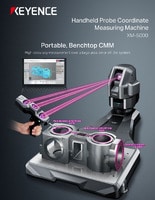
XM Series Handheld Probe Coordinate Measuring Machine Catalog
Brochure for the XM-5000 Series Handheld CMM. Portable CMM to easily and accurately measure 3D and GD&T features anywhere including the shop floor and in the machine tool.