Continuous Inkjet Printers / Case Coder
Coding on Meat and Poultry Packaging
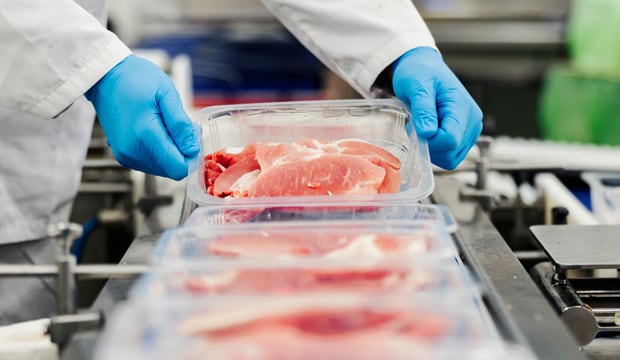
Meat and poultry processing facilities move quickly. Not only that, but their packaging surfaces can vary, and their overall conditions often involve moisture, temperature changes, and frequent sanitation cycles. In this intense context, inkjet coding for the meat industry must operate as part of the production line rather than a standalone process. Reliable meat and poultry coding supports traceability, packaging flow, and downstream handling without introducing delays or manual intervention.
KEYENCE continuous inkjet (CIJ) printers are built to perform in these demanding conditions, delivering consistent coding across a variety of meat and poultry packaging formats, all while fitting into existing line layouts.
Enhancing Hygiene and Efficiency in Meat & Poultry Production Lines
Hygiene considerations are taken into consideration for nearly every equipment decision in meat and poultry facilities. Coding solutions for meat producers must apply information without contacting the package, reducing the risk of contamination while keeping pace with high-speed lines. Non-contact inkjet printing aligns with these requirements by marking packaging directly as it moves through the line.
The efficiency of the chosen equipment also depends on how well it handles environmental variation, such as condensation, cold-chain exposure, and frequent washdowns, all of which can disrupt print quality. Industrial inkjet printers for poultry and meat applications are expected to operate steadily through these shifts, allowing production teams to maintain throughput without adjusting coding settings throughout the day.

Lot/Date Coding and Marking on Meat and Poultry Packaging
Trays
Traditional coding methods struggle with trays due to irregular surfaces. The MK-G Series uses a non-contact method of printing to help reliably print on different shapes and surfaces.
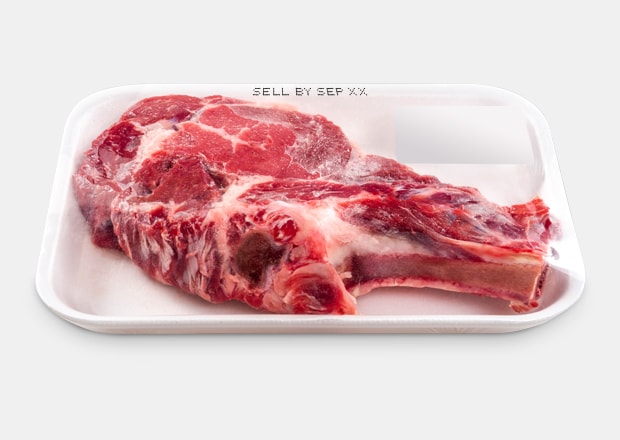
Printing example
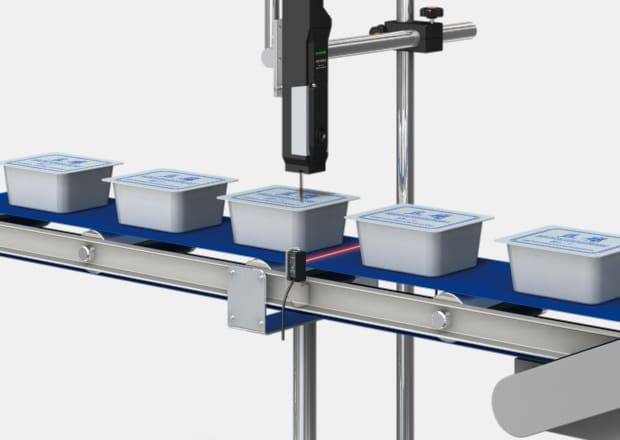
Installation example
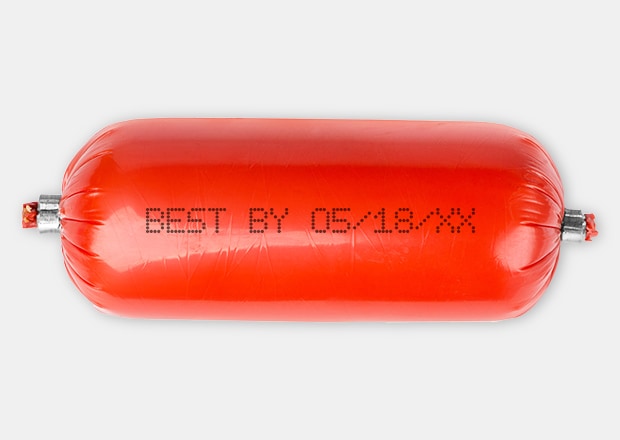
Printing example
Chub Packs
A key challenge in coding and marking chub packs is maintaining consistent quality with varying surfaces and temperature levels. The MK-G Series addresses this with self-diagnostics and automatic cleaning, ensuring high-quality printing.
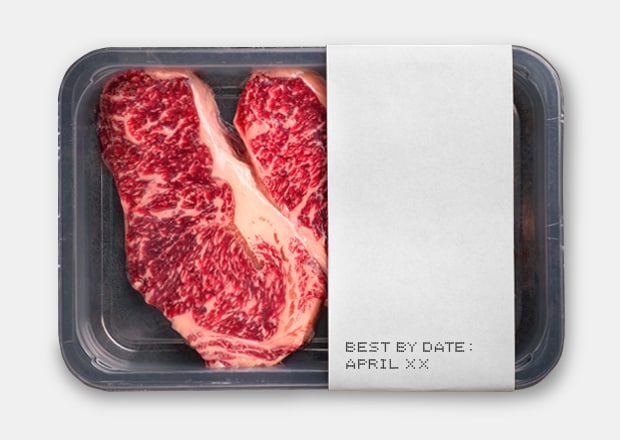
Printing example
Cartons/Sleeves
Traditional manual stamping and labeling on cartons are slow and error-prone. The MK-G Series contains internal sensors that check ink quality multiple times per second, allowing it to print at high speeds while maintaining clean codes.

Challenges in Coding and Marking on Meat and Poultry Packaging
Skilled Labor Shortages
Skilled labor shortages increase downtime for printers requiring specialized skills and training. With self-diagnosing and automatic troubleshooting features, the MK-G Series allows staff to focus on other complex tasks.
Self-Diagnosis Followed by Automatic Cleaning When Necessary
INDUSTRY FIRST Smart Startup
To start the MK-G Series, simply press the Smart Startup button. The printer will automatically obtainthe device status and select the necessary cleaning method. Cleaning is performed only when required and the minimum amount of solvent isused, significantly reducing running costs.
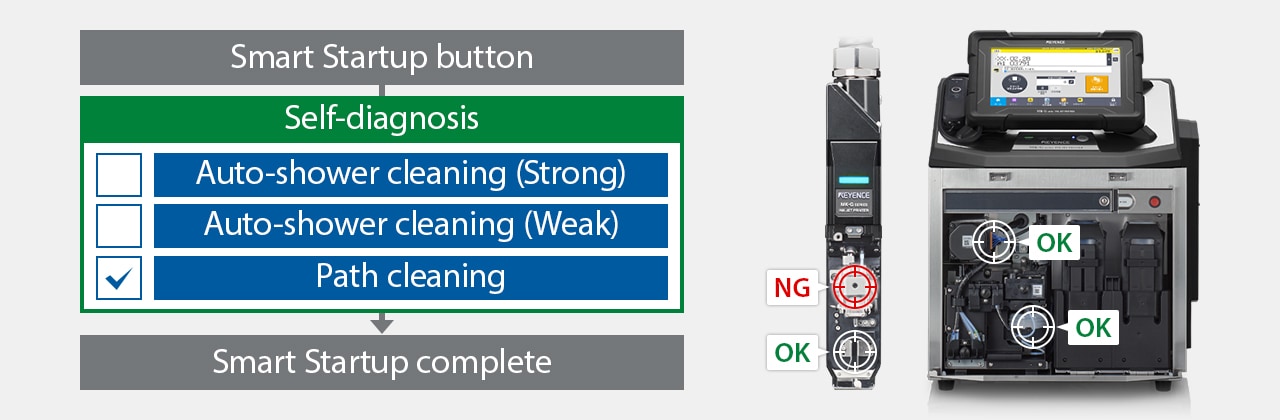
Using the MK Dock enables self-diagnosis and cleaning to ensure stable startup.
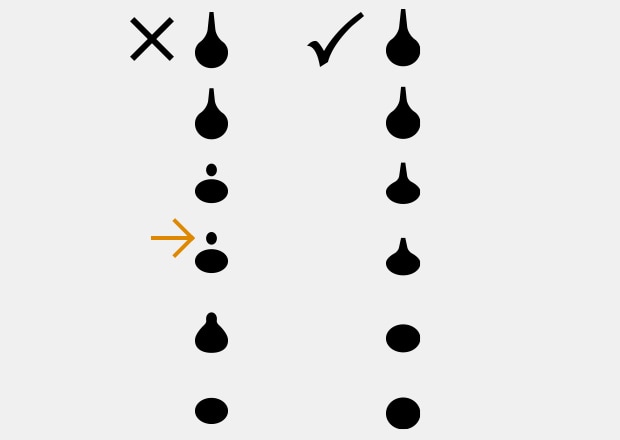
Particle state:
If the optimum ink state is not maintained, the inside of the head may become dirty, and print quality may deteriorate.
Print Quality
Coding and marking on meat and poultry packaging is challenging due to extreme temperatures and rough handling. MK-G Series continuous inkjet printers ensure consistent, legible results by using internal sensors to monitor ink quality and viscosity levels.
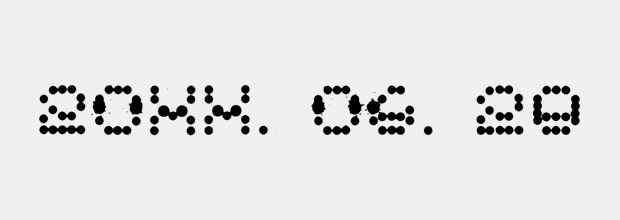
Less-than-optimal state of particles

Optimal particle state
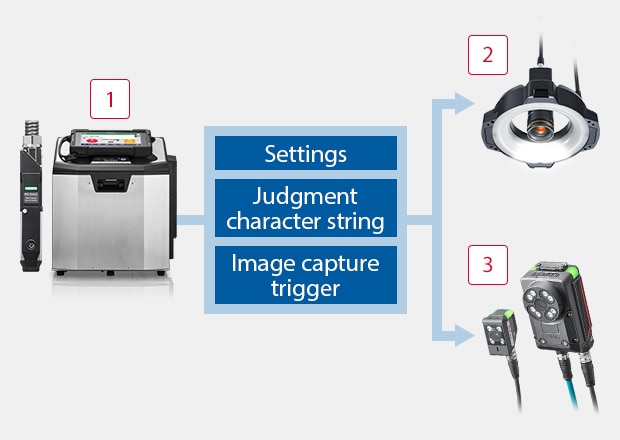
Easily link to a print inspection device with just a LAN cable
Coding Accuracy
With built-in features like easy connection to an external inspection device, the MK-G Series helps eliminate challenges relating to print and coding errors.
-
1Continuous Inkjet Printer MK-G Series
-
2Intuitive Vision System CV-X Series
-
3Vision Sensor with Built-in AI IV4 Series
Challenging Environment
Changes in environmental factors, like temperature, can cause ink adhesion and drying issues. MK-G Series industrial inkjet printers feature ink technology that endures in various conditions.

How KEYENCE Coding Solutions Meet Meat & Poultry Industry Regulations
Regulatory compliance in meat and poultry processing depends on accurate and legible product identification. Lot codes, production dates, and other required information must remain readable through packaging and well beyond distribution; when codes degrade or become inconsistent, traceability becomes almost impossible to track.
Coding solutions for meat producers support compliance by applying information that withstands handling, storage, and transport. Clear coding allows processors to respond quickly if products need to be isolated or reviewed. Rather than treating compliance as a separate task, inline coding integrates these requirements directly into normal production workflows. For the best encompassing coding solution, the MK-G1000 serves as the primary packaging printer, while the CC-1000 Series is the go-to secondary packaging printer, ensuring seamless, efficient compliance throughout the process.
Key Features for Meat & Poultry Producers Using KEYENCE Inkjet Printers
Packaging diversity is common in meat processing facilities. Trays, chub packs, cartons, and sleeves all move through the same production lines, and each presents different surfaces and orientations. That means that printers for meat packaging must accommodate these variations without extensive reconfiguration.
CIJ systems address this by supporting consistent print quality across irregular or curved surfaces while maintaining line speed. Internal monitoring helps keep ink conditions stable, which promotes uniform output during long production runs. For operations handling processed products, a package printer for processed meat must also adapt to frequent changeovers without adding setup time or increasing operator workload.
Reducing Downtime and Improving Traceability in Meat & Poultry Production
Coding interruptions tend to show up quickly on meat and poultry lines. Packaging slows, inspection timing shifts, and backlogs start to form downstream. Predictable startup behavior and steady operation during long shifts help keep those issues from spreading.
Inkjet coding for the meat industry applies identifiers as products are packaged. When those codes remain consistent, teams can follow product movement through storage and distribution without adding extra checks. Inspection systems can also confirm print quality in-line, reducing corrections without stopping the line.
What Advantages Does KEYENCE Inkjet Technology Offer over Traditional Coding Methods in Meat Production?
Inkjet printing applies variable information directly to packaging during production rather than relying on labels. This reduces the need to swap materials during changeovers and keeps coding consistent when packaging conditions vary across runs.
Get in Touch for a Free Trial of KEYENCE Inkjet Printers

FAQs About Date Coding in the Meat and Poultry Industry
How Does Coding on Meat and Poultry Packaging Enhance Traceability and Compliance?
Quality coding on poultry packaging ensures product information and data, such as barcodes and production dates, are legible and consistent for traceability and compliance requirements. This allows for a quick response in the event of a recall.
How Does the KEYENCE CIJ Coding and Marking Technology Improve Efficiency in Meat and Poultry Packaging?
CIJs for the food and beverage industry feature self-troubleshooting and automatic cleaning, which free up skilled labor, increasing output, and reducing downtime.
How Does the KEYENCE CIJ Ensure Accuracy and Durability in Lot/Date Coding on Meat and Poultry Packaging?
KEYENCE continuous inkjet printers ensure accurate, durable lot/date coding on meat and poultry packaging with reliable ink quality-sensing technology and an easy-to-use interface.
What Role Do Coding and Marking Play in Reducing Product Recalls in the Meat and Poultry Industry?
Clear and accurate product coding meets labeling requirements like allergen alerts and nutritional info, helping prevent allergic reactions for customers and ensuring food safety.
How Do Coding and Marking Contribute to Quality Control in Meat Production?
Coding and marking on meat and poultry packaging materials assists food processors, packers, and engineers in producing and packaging safe and healthy food products.
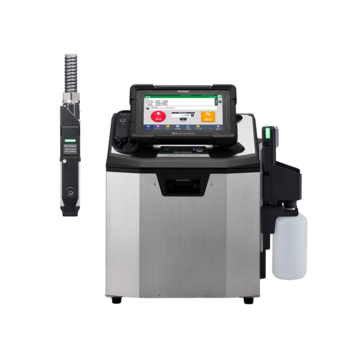
Related Products
Related Downloads
-

Continuous Inkjet Printer Application Guide
This guide explains continuous inkjet (CIJ) printer applications together with pictures and illustrations. It contains many installation examples in various industries divided into food, medicine, and cosmetics; electrical machinery and electronics; and automotive, metal, and others. These examples show printing on targets specific to each industry.


![Process-specific Marking Applications [Food/Pharmaceutical Industry]](/img/asset/AS_133442_L.jpg)