Continuous Inkjet Printers / Case Coder
Types of Inkjet Case Coders for Industrial Packaging
Key Takeaways
- Choosing the right industrial case coder dictates print resolution, character size, and operating costs.
- Thermal inkjet (TIJ) printers offer high-resolution marks for detailed barcodes on secondary packaging.
- Valve jet coders excel in dusty environments, providing highly visible large characters on corrugated cases.
- Continuous inkjet printers support highly viscous and quick-drying inks, ideal for industrial production.
Industrial case coders are designed to print variable information directly onto corrugated shipping cases as they move through secondary packaging lines. The ink delivery method inside the printer determines print resolution, character size, operating costs, and how the system can perform in real production conditions.
On-Demand Type
With this method, only the amount of ink particles necessary for printing is discharged.
The ink nozzles are arranged vertically within the printer. Ink particles are instantaneously discharged from the nozzle and are sprayed on the target. Piezo, thermal, and valve are the methods used to apply pressure to the ink particles and discharge them.
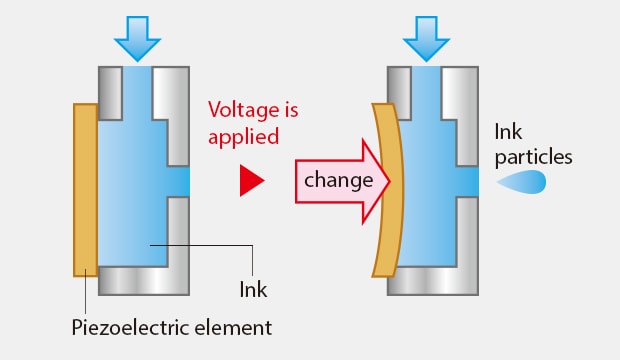
Piezoelectric Type (Office/Industrial)
In this method, a piezoelectric (piezo) element, whose volume is deformed when voltage is applied, is used to discharge ink particles. This element is attached to the component that is filled with ink.
Then, the volume deformations are used to apply pressure to the ink, which discharges ink particles from the nozzle.
Advantages
- The amount of ink discharged can be controlled with high accuracy by controlling the voltage.
- Because it does not apply heat to the ink, this method is highly durable and resistant to the influence of the operating environment.
Disadvantages
- Because a piezo element is required for each nozzle, the structure can become complicated.
- It is easy for nozzles to become clogged if air bubbles form in the ink.
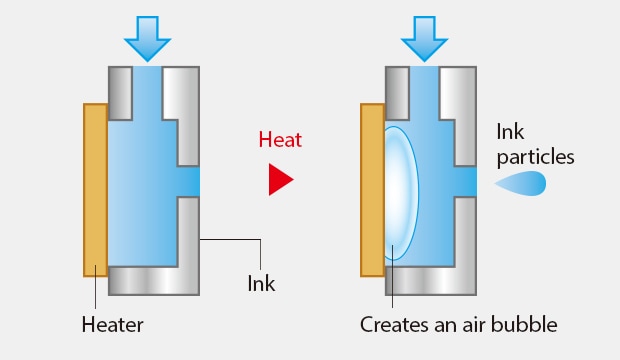
Thermal (Valve) Type (Office/Industrial)
In this method, a heating element is used to apply heat to the ink, which causes bubbles to form and discharge ink particles. The heating element is attached to the component that is filled with ink. Applying heat to the ink causes a bubble to form, which discharges ink particles from the nozzle.
Advantages
- The structure is comparatively simple, which makes it easy to miniaturize these printers.
- It is easy to improve the printing resolution.
Disadvantages
- It is easy for the ink to deteriorate due to the heat applied.
- Print heads have short service lives.
- Because moisture evaporates from the nozzles, it is easy for nozzles to be clogged due to drying out.
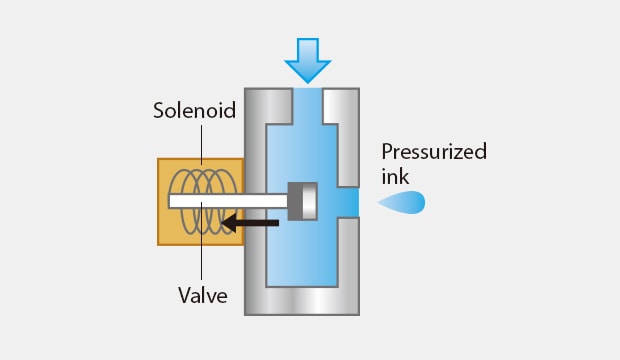
Valve Type (Industrial)
In this method, a solenoid is used to open and close the nozzle cover, which discharges ink particles.
By opening and closing the valve, the pressurized ink is discharged from the nozzle.
Advantages
- Because pressurized ink is discharged, it is easy to increase the distance from the nozzle to the target.
Disadvantages
- Because the ink particles are large, it is easy for the print quality to degrade.
Continuous Type
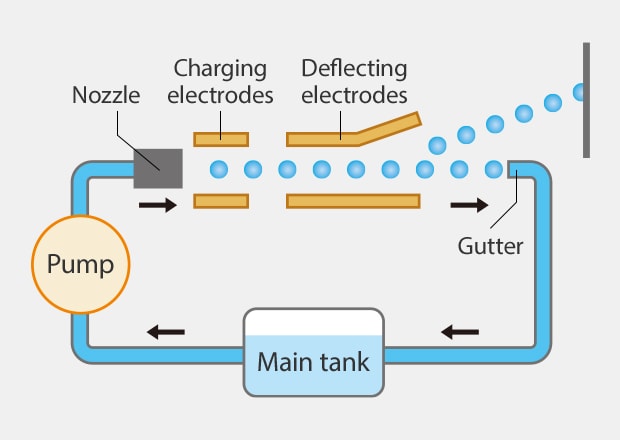
In this method, ink particles are continuously discharged from the nozzle. The ink particles are charged with electrostatic, and deflecting electrodes are used to deflect the ink particles so that they are sprayed on the printing surface.
Ink particles that are not deflected are collected, returned to the ink tank, and reused. Even when printing is not being performed, ink is continuously discharged at all times, which is why they are called continuous-type printers. This is the most commonly used method among continuous inkjet printers.
Advantages
- Because ink is discharged at high pressure, highly viscous ink can be used.
- Because ink is discharged continuously, quick-drying ink can be used.
Disadvantages
- Due to the large-scale structure, it is difficult to miniaturize these printers. These printers are not suited for office use.
Thermal Inkjet (TIJ) Case Coders
Thermal inkjet systems bridge the gap between small character coding and large-format case marking, offering higher definition without the need for a full-scale bulk ink system.
As packaging lines move towards improving their traceability and higher data density on secondary packaging, TIJs have gained traction in applications where case information mirrors primary product labelling requirements.
How It Works
Thermal inkjet systems use heat to eject droplets of ink. A resistor inside the cartridge rapidly heats ink within the small chamber, which forms a vapor bubble. The bubble expands and forces a droplet through the nozzle. As the ink leaves the printhead, fresh ink refills the chamber, and the cycle repeats.
The printhead is integrated into the cartridge, which simplifies the replacement process and reduces the mechanical complexity of the equipment.
Advantages
TIJ printers are known for producing high-resolution marks in a compact footprint. This makes them suitable for more detailed barcodes and small-format information on secondary packaging, and cartridge-based operation simplifies ink handling and keeps daily maintenance predictable.
Limitations
The working distance of a TIJ printer is typically shorter than that of other large character inkjet printers. When greater print height is required, multiple heads are stitched together, which adds to any mounting and alignment considerations. In high-coverage corrugated case coding, cartridges may need to be replaced more frequently, and those maintenance costs need to be evaluated.
Best Applications
TIJ printers are commonly selected for production lines that operate at moderate speed, while keeping print resolution is a priority and environmental conditions are stable. For controlled secondary packaging areas, it remains a viable and practical option among industrial case coders.
Valve Jet Case Coders (Low-Resolution)
Valve jet systems are frequently used in distribution-heavy industries where outer case readability drives the operational efficiency. Larger character formation improves visibility during pallet staging and warehouse/inventory scanning, particularly when cases are stacked or wrapped.
These systems are also often configured with adjustable printhead mounting positions. Since the droplet formation is pressure-driven rather than heat-based, its performance can remain stable across longer throw distances. These configurations support installations in any position from the conveyor path without having to sacrifice the density of markings.
How It Works
Valve jet systems, often categorized as large character inkjet printers, use a pressurized ink supply and mechanically controlled valves to form droplets. Each nozzle contains a spring-loaded plunger that seals the orifice. When a solenoid activates, the plunger retracts, which releases the droplets toward the substrate. After that, the valve is closed immediately.
Droplet release is controlled mechanically through timed valve movements and pressurized ink flow. Each actuation physically lifts the plunger from the nozzle seat, which allows a measured volume of ink to pass through before the valve reseals. This configuration produces a more consistent drop volume even when minor line vibration or spacing variation occurs.
Advantages
Valve jet case coders are built for outer case visibility, and, on corrugated packaging, the larger droplet size improves opacity and readability in warehouse and distribution environments. These systems are frequently used when character height must be easily seen from a distance. In distributing centers where labels may be applied, this type of direct marking supports quick visual ID without scanning.
Many valve jet systems operate with bulk ink supplies, which supports longer production runs and reduces the frequency of consumable replacements. This design also tolerates dusty environments more effectively than some other case coder printer types.
Limitations
The valve jet case coder has a lower resolution compared to high-DPI technologies. These systems are not typically used for dense graphics or compact 2D codes where character formation focuses on visibility rather than fine detail.
Because the droplet size is larger, small text may appear less refined than with thermal or other high-resolution systems.
Best Applications
Valve jet is widely used for large alphanumeric case codes, date stamps, and lot identification printed directly onto shipping cases. It performs very well in industrial environments where durability and the size of the mark outweigh the need for detailed graphics.
Among industrial case coders, valve jet larger character inkjet printers are commonly selected for high-throughput corrugated case coding where there is a requirement for bold and readable text.
Request an Industrial Inkjet Printer demo with KEYENCE.

Related Products
Related Downloads
-
Continuous Inkjet Printer Application Guide
This guide explains continuous inkjet (CIJ) printer applications together with pictures and illustrations. It contains many installation examples in various industries divided into food, medicine, and cosmetics; electrical machinery and electronics; and automotive, metal, and others. These examples show printing on targets specific to each industry.
-
![Inkjet Printer Tech Guide [BASIC KNOWLEDGE EDITION]](/img/asset/AS_114378_L.jpg)
Inkjet Printer Tech Guide [BASIC KNOWLEDGE EDITION]
Continuous inkjet (CIJ) printers work by discharging ink particles to print information such as characters and figures on targets. This document describes the differences between industrial use inkjet printers and office-use printers, as well as their structures, circulation principles, and application examples.