Continuous Inkjet Printers / Case Coder
Continuous Inkjet Printers / Case Coder
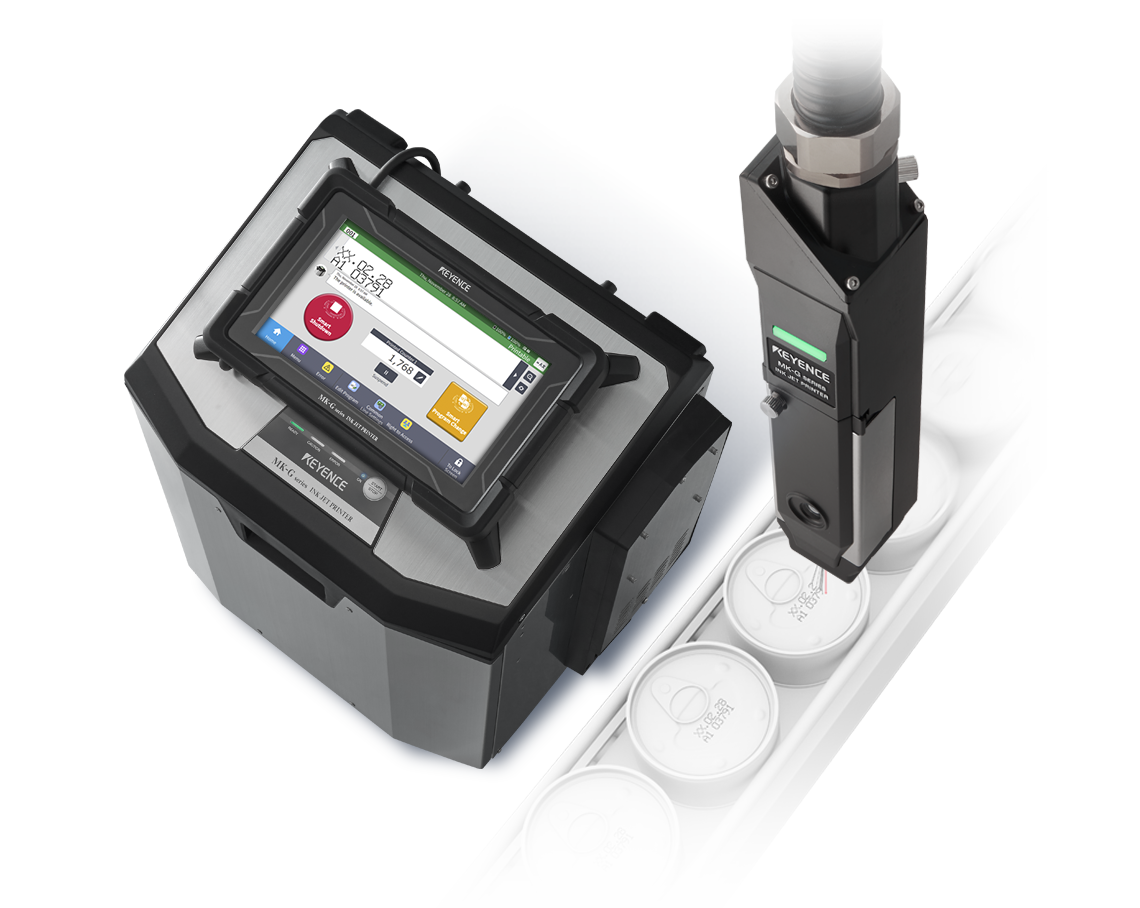
The KEYENCE lineup of continuous inkjet printers includes the MK-G Series for all types of objects, such as individual packages, containers, cartons, bottles, construction materials, and electronic components, as well as the CC-1000 Series for printing on corrugated cardboard and kraft bags. We offer the best model for each customer's application.
Product Lineup
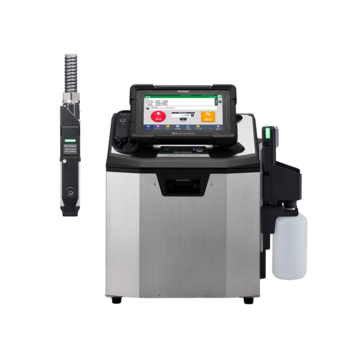
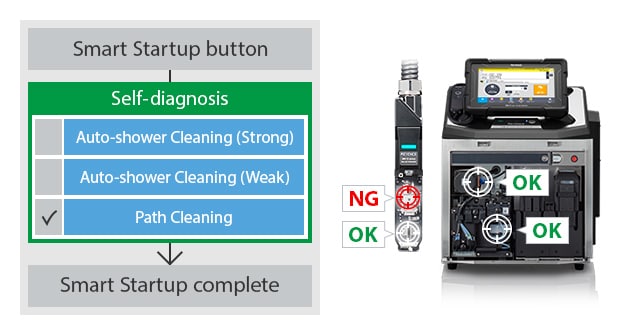
The MK-G Series is the world's first self-troubleshooting continuous inkjet printer, eliminating the guesswork of inkjet maintenance and enabling operation without specialized product knowledge or skills. By incorporating KEYENCE sensor technologies to enhance its self-diagnostic capabilities, the MK-G Series can automatically perform maintenance and troubleshooting, much like a trained inkjet technician. The unit also features automatic cleaning before every shutdown, even in the event of a power disruption, as well as remote monitoring and operation from a PC or smartphone.
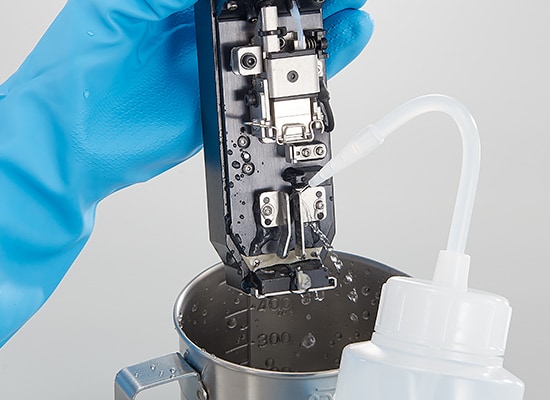
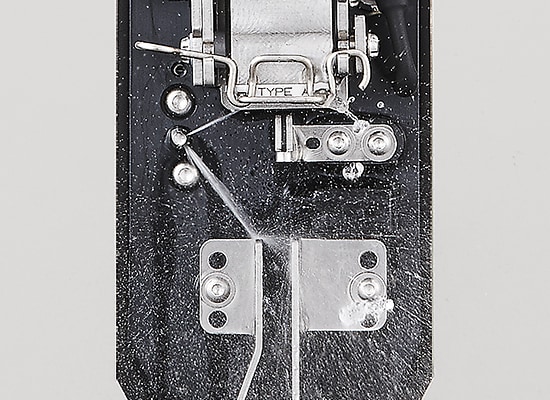
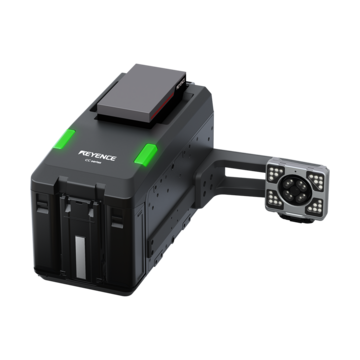
KEYENCE has been an innovative leader in the inkjet printing industry since the early 1990s. By integrating proprietary sensor and machine vision technologies, the CC-1000 Series provides a complete secondary packaging solution for high-quality printing and inspection. Designed to solve conventional box printing challenges, the CC-1000 simplifies setup and maintenance while delivering crisp, reliable codes and consistent print quality.
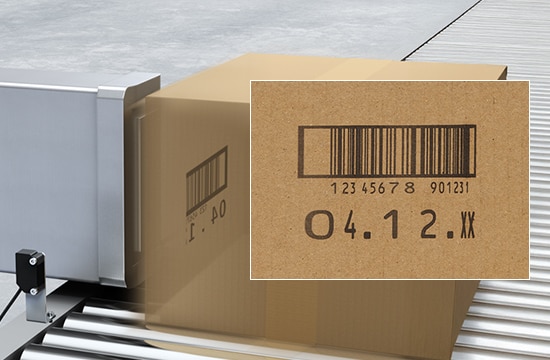
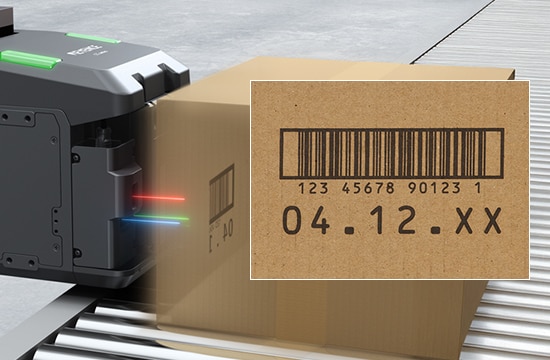
What is a Continuous Inkjet Printer / Case Coder?
Continuous inkjet printers provide non-contact, high-speed marking for a wide range of materials, including packaging, plastics, and metals. Designed for high-throughput production lines, CIJ systems enable consistent coding of dates, batch numbers, and barcodes across multiple industries.
・Print on curved and uneven surfaces
・Support high-speed production lines
・Reduce downtime with low maintenance requirements
Case coders provide reliable, high-quality marking directly onto corrugated boxes and shipping cases. Also designed for high-throughput production lines, case coding systems enable consistent printing of dates, batch numbers, barcodes, logos, and other variable information across a wide range of secondary packaging applications.
・Print directly on corrugated boxes and cases
・Produce crisp, legible codes for reliable identification
・Reduce downtime with simple setup and maintenance
Food & Beverage
Print expiration dates, lot codes, and barcodes on packaging at high speeds.
→ View Food & Beverage solutions
Pharmaceuticals & Medical Devices
Ensure accurate batch coding and traceability for compliance and safety requirements.
→ View Pharma applications
Packaging & Logistics
Mark cartons and cases with shipping and tracking information for distribution.
→ View Packaging & Logistics solutions
Electronics & Electrical Components
Apply precise codes and markings on small or delicate components.
→ View Electronics applications
Automotive & Industrial Manufacturing
Support identification and traceability across components and assemblies.
→ View Manufacturing applications
Plastics, Metals, and Materials
Print consistently on a wide range of substrates, including non-porous surfaces.
→ View Material-based applications
Continuous inkjet printers and case coders are used at different stages of production to meet distinct coding and marking requirements.
CIJ printers are typically used for primary packaging, applying lot codes, expiration dates, and product details directly to bottles, pouches, and film. Compact printheads fit easily into filling and sealing equipment, while quick-drying inks ensure clean, consistent printing on curved or non-porous surfaces.
Case coders are used for secondary packaging, printing large text, barcodes, and graphics on cartons and shipping boxes. On food and beverage lines, CIJ printers mark individual containers, while case coders label the outer packaging used for storage and distribution.
Together, these systems support end-to-end traceability across production and packaging processes in industries such as food, pharmaceuticals, and manufacturing.
Non-Contact Inkjet Printing
Print without physical contact between the printer and substrate.
→ Maintain consistent marking on uneven, curved, or delicate surfaces without damaging products.
High-Speed Printing Capability
Designed to keep up with fast-moving production lines.
→ Ensure clear, reliable codes without slowing down throughput.
Self-Cleaning Printhead Design
Automatic cleaning minimizes ink buildup and clogging.
→ Reduce maintenance time and prevent unplanned downtime.
Versatile Ink Compatibility
Supports a wide range of inks for different environments and substrates.
→ Adapt to various materials and conditions, including harsh or high-moisture environments.
Compact, Industrial Design
Built for integration into existing production lines with minimal footprint.
→ Install easily in tight spaces without disrupting operations.
Multi-Line and Variable Data Printing
Print text, barcodes, and variable information in multiple formats.
→ Meet traceability and compliance requirements across industries.
Seamless Integration with Production Equipment
Easily install printheads on filling machines, packaging lines, and conveyors without disrupting production.
→ Maintain continuous operation and ensure consistent printing on moving products.
Modern production lines require coding and marking solutions that keep pace with high speeds, frequent changeovers, and a wide range of materials. KEYENCE offers both continuous inkjet (CIJ) printers for high-resolution coding and case coders for large character marking, designed to maintain consistent output across industries such as food, pharmaceuticals, and electronics.
What Sets KEYENCE Apart
Self-Troubleshooting Technology
Automatically detects and resolves issues without operator intervention.
→ Keeps production running without constant monitoring or manual adjustments.
Integrated Inspection and Control
Built-in connectivity with inspection systems eliminates the need for separate hardware.
→ Simplifies system setup while ensuring consistent, verified print quality.
Operator-First Design
Intuitive setup tools, remote adjustments, and automated calibration reduce complexity.
→ Minimize training requirements and simplify daily operation.
All-in-One Marking Solutions
Supports both high-resolution CIJ printing and large character case coding within a unified platform approach.
→ Standardize marking solutions across multiple stages of production.
Application Flexibility Across Industries
Proven performance across diverse substrates, environments, and production conditions.
→ Easily adapt to new products, materials, and packaging requirements.
・Date and lot code printing on glass bottles
・Lot code and date code printing on plastic bottles and containers
・Date and lot number printing on cans
・Serial number printing on extruded plastics (wire, cable, piping)
・Date code printing on pouches
・Serial number printing on metal parts
・Case coding on corrugate and cardboard boxes
・Date printing on packaging film
・Large character marking for kraft packaging
・Case coding on folding cartons
・Serial number printing on building materials
・Serial number and 2D code printing on PCBs
・Date and serial number printing on cartons
・Large character printing on pallets and lumber
・Case coding on corrugate trays
Frequently Asked Questions About Continuous Inkjet Printers / Case Coder
Industrial-use inkjet printers can print on a wide variety of materials such as metals, resins, glass, packing films, cans, and PET bottles.
In order to print on products moving on production lines, quick-drying ink, which dries in under 1 second, is used. This enables printing on materials other than just highly absorbent ones, such as paper and cardboard. As such, these printers are used in a wide range of applications in the food, medical, cosmetic, electrical and electronic components, transportation, and metal industries.
Dye-based and pigment-based inks are commonly used with continuous inkjet printers. Dye-based ink can be quickly absorbed by print targets, which allows fast dry time. It also doesn't precipitate when mixed with liquid, making the printer easy to maintain. On the other hand, color pigment ink sticks to the surface of print targets and gives long-term fade resistance. However, precipitation will occur with this type of ink. Therefore, the printer needs to have an auto-circulation feature to ensure no ink hardening.
Industrial continuous inkjet printers have a wide range of applications across various industries, most notably the packaging industry, as CIJ printers excel at printing lot codes, expiration dates, batch numbers, 1D and 2D barcodes, and other relevant product information.
KEYENCE's MK-G Series offers advanced features that enhance the reliability and performance of CIJ printers in all industries. With a direct connection to print inspection equipment, the MK-G Series eliminates any chance of incorrect or missing printed details, ensuring product traceability and compliance. Its auto-cleaning feature ensures cleaning is a hands-free process, maintaining print quality.
Industrial continuous inkjet printers are a noncontact, versatile, and high-speed way to print lot codes and date codes on substrates along a manufacturing line. These printers utilize an ink tank system to deliver ink through a nozzle, where it is fragmented into numerous droplets via high-frequency vibration. After the droplets are produced, specific ones are charged using electrodes. The stream of droplets then navigates through deflector plates, generating an electrostatic field.
As the charged drops traverse the deflector plates, they are redirected out of the print head onto the product, shaping the desired message. Droplets that remain uncharged are recirculated within the system for future use. This process generates the height or Y-axis of printed text. At the same time, the substrate or print head must be moving to help generate the width or X-axis.
In the past, industrial continuous inkjet printers required frequent maintenance and troubleshooting by a skilled engineer, maintenance technician, or third party service tech.
With the release of KEYENCE's MK-G Series self-diagnosing and troubleshooting CIJ printers, any beginner operator can press a button or follow along with the on-screen, easy-to-follow instructions and videos to run production. This reduces the need for skilled/trained on site staff, disruptions during employee changeover/turnover, and expensive service contracts.
When evaluating a CIJ printer, consider the material, surface texture, print speed, and ink formulation required. For non-porous or curved surfaces, a non-contact system such as the MK-G Series maintains print quality. Automated cleaning, predictive diagnostics, and remote monitoring functions reduce maintenance effort and keep line uptime high.
CIJ printers mark lot codes and dates on bottles, cans, and pouches as products move through the line. Case coders print barcodes and tracking data on cartons at the packing stage, keeping packaging consistent from filling to shipment.
The MK-G Series prints more than 2,500 characters per second with encoder control, and the CC-1000 Series runs at up to 100 meters per minute. Both keep codes clear even as line speed or spacing changes.
This guide explains continuous inkjet (CIJ) printer applications together with pictures and illustrations. It contains many installation examples in various industries divided into food, medicine, and cosmetics; electrical machinery and electronics; and automotive, metal, and others. These examples show printing on targets specific to each industry.
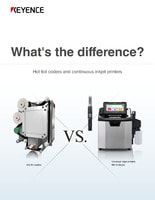
This guide explains the printing principles and the workflow up to printing by comparing hot foil coders and continuous inkjet (CIJ) printers. Both machines are analyzed from the aspects of productivity, quality, management, and running costs. Tips for solving accidents caused by date coding mistakes are also described.
This is a technical guide describing basic knowledge of continuous inkjet (CIJ) printers from mechanisms such as the types, printing fundamentals, and internal structure, to running costs and legal compliance. Subsequent issues will also be available. By reading all of these issues, you can understand the entire overview of continuous inkjet (CIJ) printers.
![Inkjet Printer Tech Guide [BASIC KNOWLEDGE EDITION]](/img/asset/AS_114378_L.jpg)
Continuous inkjet (CIJ) printers work by discharging ink particles to print information such as characters and figures on targets. This document describes the differences between industrial use inkjet printers and office-use printers, as well as their structures, circulation principles, and application examples.